Minds of the Press, Vol 21

Morning Bell Editions
The last time we interviewed the team at Morning Bell Editions over two years ago, we interviewed them as an upcoming new press that was working on their first production. Two years later, they have delivered two wonderful projects and are in the midst of the Kickstarter for their third, The Jungle Book. Now Morning Bell has a loyal and dedicated following and is known for producing modern fine press masterpieces of classic literature. Everything they have promised before their first production has come to fruition and their first release of Pinocchio was my personal favorite fine press production of 2025. We hope you enjoy this conversation, where we reconnected with Federico, Davide and Antonio to hear more about their plans for The Jungle Book and beyond.
Q: When we spoke in 2024, Pinocchio hadn't launched yet, and you were still imagining what Morning Bell could become. Two years in, how does the reality compare to what you pictured? What surprised you most during that time?
It is a pleasure to speak with you again, Zach. These have been two very intense years, so intense that they have felt like ten to us. When we spoke two years ago, Morning Bell was just beginning: it was an idea taking shape. We certainly hoped to find people who, like us, could love books made by hand in the traditional way, but we could not be sure. The positive reception of Pinocchio first and then Frankenstein surprised us in terms of numbers.

The greatest surprise, however, was discovering the passion and friendship, because that is truly how we feel about it, of a community of wonderful people spread all over the world. We now communicate with them every day, and their affection is entirely mutual. The most beautiful thing is that these exchanges are about more than suggestions, observations, titles and, sometimes, constructive criticism. We also discuss the small and large problems of the contemporary world.
Q: You told me you were making books "primarily for passion and not for profit." With three editions now in the works, has that held up? What has the business side of running a press taught you that the bindery and the antiquarian trade didn't?

Absolutely. I hope our editions show that each time we try to raise the bar in our work, creating books that, while hopefully being easily recognisable as “ours,” are always different. Challenging ourselves in this way, and sometimes even making things difficult for ourselves, lies at the heart of every work we have conceived and will conceive with the help of the artists who work alongside us. The real pleasure lies in making these books and putting our dedication and imagination into projects that bring a little joy to the people who accompany us on this adventure. Over these two years, we have received so many messages of thanks and expressions of appreciation. They have filled our hearts with gratitude and renew our energy every day.
We must be honest: our previous professional experiences, which we still pursue alongside Morning Bell, had done little to prepare us either for running a publishing house like ours or for creating books such as Pinocchio, Frankenstein and, of course, The Vampyre from scratch. Sometimes, as with Frankenstein, we have not estimated production times accurately. With our commitment to making everything as fully by hand as possible, and to placing no limits on either our imagination or the artist’s, we included so many distinctive features that production, which we are now completing, has been extremely demanding. This has given us a better understanding of the time required for each stage of the work and has already taught us lessons that we will immediately put into practice with Kipling’s The Jungle Book.
Q: As you mentioned, you recently announced your third production would be Rudyard Kipling’s The Jungle Book. How did you land on this title and why now? You named Kipling as one of your favorite authors in our last conversation. Was this always on the list from the beginning?
We are being quite sincere when we say that Kipling’s The Jungle Book was certainly one of the titles we wanted to publish, but we had not planned to do so this soon. We already have a schedule of forthcoming titles, but we have always been very open to recognising the signs and opportunities that life sometimes puts before us. That is exactly what happened with The Jungle Book. One day, almost by chance, some illustrations by a talented young artist, Brighe, came into our hands. One in particular, depicting an animal in a jungle, was a true revelation. We completely changed our planned schedule and said: “We must contact this artist straight away and ask her to illustrate Kipling’s The Jungle Book.” The rest came from the enthusiasm with which Brighe embraced the project and the pleasure we found in working with this young illustrator and her wonderfully vivid imagination.

Q: The Jungle Book is a collection of stories, rather than a single novel. How did you decide which text to use, and does the structure change how you plan the book's design, pacing, and illustration?
Choosing to use the original text of the first edition came naturally to us, just as it had with Frankenstein, Pinocchio and The Vampyre. In the case of Frankenstein, we only discovered afterwards that other fine art publishers, as well as the vast majority of mainstream publishers, had never used the original first edition text. This choice probably stems in part from Antonio’s work as an antiquarian bookseller, which regularly brings him into contact with first editions. But it also comes from our belief that publishing these books in the original versions that established their success when they first appeared is a service both to our readers, who are too often accustomed to reading works in “modernised” editions, and to the authors of these great masterpieces.
The Jungle Book, in particular, is too often presented through the Mowgli stories alone, bringing together tales from different editions. We felt that the original edition, as we are presenting it, with all the stories from the first edition, conveys better than any other version the contradictions, life experiences and storytelling skill of an author like Kipling, who spent his entire life suspended between two worlds: India and England. Certain aspects of Mowgli’s experience, and even more so the full collection of stories in the first edition of The Jungle Book, convey a contrast between two worlds.

There is the animal world, sometimes cruel but nevertheless characterised by many positive qualities, such as sincerity, friendship and openness. Then there is the human world, too often marked by deceit, envy and hypocrisy. Of course, the decision to present all the stories in their original form led us to adjust our policy of giving the artist complete freedom, asking Brighe at the outset to create at least one illustration for each story.
Q: You mentioned that Brighe is illustrating this edition and came in a moment of inspiration. How exactly did you find her, and what about her work convinced you she was right for Kipling's world? Did you give any direction, or did you leave the interpretation entirely to her?
As I mentioned, the encounter happened entirely by chance. Brighe lives in a beautiful part of Italy, Lake Garda: a place suspended between water and mountains. Her sensitive nature has probably allowed her, from an early age, to recognise the beauty of these enchanting landscapes. By a fortunate coincidence, a friend had given Antonio a local art magazine, which we then began leafing through together. We fell in love at first sight with an illustration in its pages, without knowing who had created it. Getting to know Brighe, imagining working with a young artist and changing our publishing schedule felt almost natural.

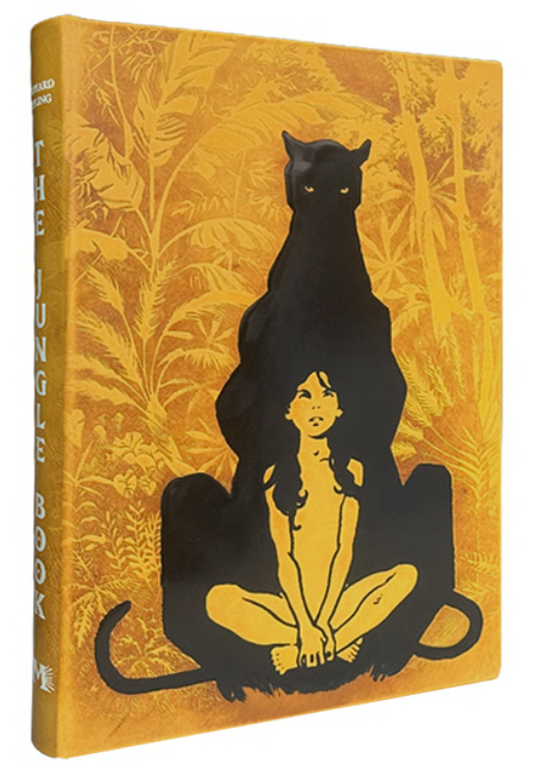
As for the second part of your question, we can confirm that we gave Brighe complete freedom of interpretation. Unlike our experience with other artists, however, developing the images involved a collaborative effort. Brighe had never illustrated an entire book, from the plates to the covers, let alone designed covers to be made by hand. It may sound simple, but creating the illustrations and then imagining covers that can be produced by hand is far from straightforward for almost anyone. Yet Brighe left us speechless. It was a new experience for her, and at first, we worked closely together on the earliest illustrations, but her creativity soon began to reveal its full strength. From the very first trials, her vision for the covers amazed us. Brighe is a true natural talent.
Q: Pinocchio's illustrations deliberately avoided showing the title character. Does this edition have an organizing concept like that, or a particular interpretive angle? How do you want to approach a story with such a long visual legacy, from the Detmold brothers to Disney and beyond?

In both Pinocchio and Frankenstein, unlike The Vampyre, for example, it is true that the protagonist is never clearly visible, only glimpsed at most. This, however, has always been the artists’ choice. Our initial guidance to every artist has been to move as far as possible from familiar imagery, whether Disney’s or other widely recognised interpretations, such as the illustrations by the Detmold brothers or those by Kipling’s son. Beyond that, the artists who work with us always have complete freedom. This is partly because we are curious to see what emerges from the imaginations of the illustrators we have chosen, and partly because we know that, given freedom of interpretation, they will naturally create images that reflect our own time, just as their predecessors reflected theirs.
Something we often say to one another is that we want to make books as they were made in the past, but with an entirely contemporary design, so that even five hundred years from now, someone looking at them will immediately be able to say: “This is a book from the first half of the twenty first century.” It is rather like what happens to us when, in our work as an antiquarian bookseller or as restorers, old volumes come into our hands. Their characteristics allow us to identify the period in which they were made with considerable accuracy, even without an explicit date.
Q: Kipling's book is set in the Indian jungle, and Morning Bell's modern aesthetic is anchored in Italian craft. Are you reflecting that setting in the materials, the binding, or the printing, such as the colors, the natural inks, or the cover materials?
That is a wonderful question. Italy’s artistic and craft traditions are the result of cultural influences from all over the world, thanks to our country’s history and its position at the heart of the Mediterranean, between northern Europe and Africa and along the trade routes connecting East and West. I would say that few cultures can claim such a rich contribution from other cultures since ancient times. Italian culture remains alive today precisely because of its ability to be continually enriched through encounters with others.
Since ancient times, countless Italians have visited India and described it to us. One example is Marco Polo, perhaps the most famous, who passed through India in 1292, after leaving Kublai Khan’s court, on his journey back to Italy, and left us accounts of what he saw. But he was not the only one. We also like to remember Niccolò de’ Conti, who lived from 1395 to 1469, Niccolò Manucci, who lived from 1638 to 1717, and, more recently, Giacinto Carena. They are all remarkable figures about whom information can easily be found online.
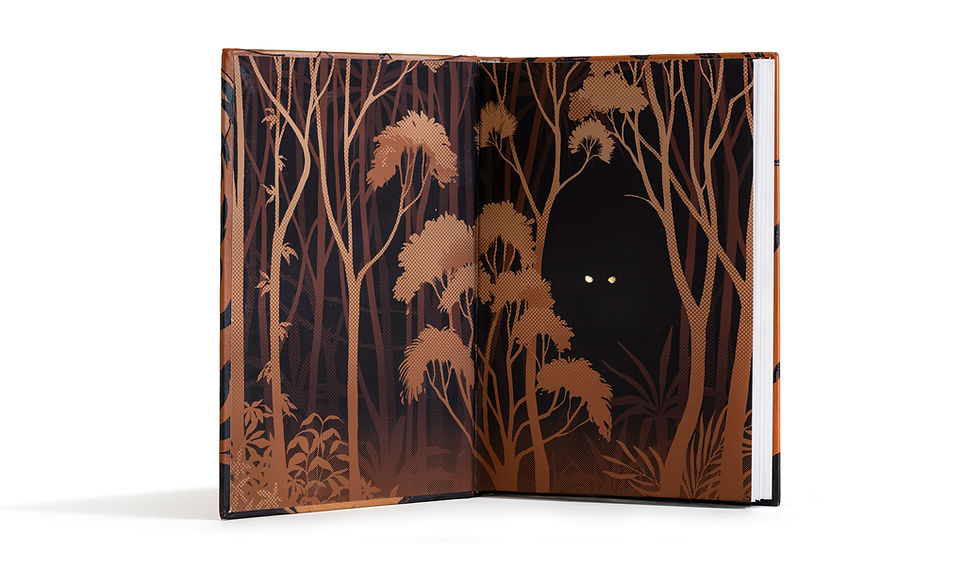
The imagery of India’s forests is therefore, in a sense, part of our nature as Italians. Indeed, several Italians who had never seen these forests illustrated and described them in the twentieth century, making the atmosphere of the East familiar to us all. We think of the writer Emilio Salgari, who created Sandokan, or painters such as Antonio Ligabue, who holds a special place in our hearts and was able to recreate those atmospheres. For us, it therefore felt almost natural to engage with the atmosphere of India, bringing it to life through the illustrations inside the book and through the design and colours of the covers and boxes. At least, it is the India we dreamed of while reading the stories of Kipling and Salgari.
Q: Fine press has a growing number of new imprints, and the collector base is global but finite. What do you think sets Morning Bell apart, and how do you want to avoid growing so fast that it compromises the handwork?
We have a very firm and, in a way, simple answer to this question. We have no intention of growing, either quickly or slowly. We are, and will remain, an artisan publishing house, because that is our philosophy. This does not mean that we might not eventually produce three or four books a year. But if that happens, we may reduce the number of copies. We do not want the need to make more and more books to take time away from the care and love we put into making them.
As for what distinguishes us from other publishers, we cannot really say. Over these years, we have seen and appreciated the work of all the other fine press publishers, and we love many of their books. We genuinely look forward to taking part in a fair so that we can meet these people who, like us, create beautiful works to bring a little joy into a world too often disfigured by the pursuit of profit at any cost.
The one thing we can say sets us apart from most other publishers, although we share it with some, is that we make everything by hand and carry out almost all the work within our own publishing house.
The exception is the printing of the text, which we often entrust to our dear friends at Archivio Tipografico in Turin. It is regarded as Italy’s leading authority on letterpress printing and is made up of a group of young people completely devoted to the art of printing. The Vampyre, for example, was made entirely by us: from printing the text and illustrations to binding the volumes and making the covers, slipcases and boxes. In other words, the rich craft heritage built over Bottega dei Gozzi’s one hundred and ten years of activity has passed entirely into Morning Bell. I do not think many publishers can claim a similar history.
Q: Last time you pictured Morning Bell working fifty years from now, maybe with your children. Two years later, has your sense of what Morning Bell is changed? What would make you feel you had gotten it right?
We believe that Morning Bell is already very close to what we imagined and wanted it to become: an opportunity to make beautiful books without submitting to the usual logic of sacrificing quality on the altar of profit. Books that bring joy both to us as their makers and to those who have shared in this dream and helped make it possible.

If the friends who follow us and continue to place their trust in us keep appreciating what we do and the philosophy behind our vision of Morning Bell, regardless of the illustrator’s style, the literary genre or the author chosen for our publications, then we will be able to say that our message has been understood: craft traditions matter, they must not be lost, and they can certainly survive in a contemporary world where the quality of industrially manufactured products continues to decline.
This interview was done in a series of communications back and forth with Morning Bell Edition and Antonio answered the questions on behalf of the whole team. If you want to order a copy of The Jungle Book or see what else is coming you can see what Morning Bell has to offer, follow at https://www.morningbelledition.com/ and check out their Kickstarter starting next week. For updates on current projects check them out on Facebook or Instagram to stay up to date on what's coming up in the future for Morning Bell Edition!
Interview by: Zach Harney, co-founder of the Collectible Book Vault


Comments