Artist Conversations, Vol. 5

Gary Gianni
Gary Gianni has spent the last five decades illustrating stories and has contributed as much as almost any artist that is still working in book illustration today. Trained as a newspaper illustrator and courtroom sketch artist in Chicago, Gianni has since transitioned into the world of books and brought to life some of the best productions in the modern fine press era. Outside the fine press world, he's probably best known to comics readers for a decade-long run drawing the Sunday Prince Valiant strip, and for work on The Shadow, Batman, and Hellboy. His illustrations for Wandering Star's editions of Robert E. Howard, The Savage Tales of Solomon Kane, Bran Mak Morn: The Last King, and the Del Rey Conan volumes that followed, are widely credited with helping spark the modern boom in illustrated limited editions of classic pulp and fantasy fiction. He's gone on to illustrate drawings for George R.R. Martin's A Song of Ice and Fire, A Christmas Carol, Hitchhiker's Guide to the Galaxay and Paulo Coelho's The Alchemist. I was delighted to get the opportunity to talk with him about how he got started, working with fine press publishers, and the future of the written word.
Q: Who were the artists or illustrators you looked to most as a young artist in Chicago, and is there a single image or book from that period you can point to as the moment you knew this was the career you wanted?

I’m not sure there’s a single image that made an impression on me. Maybe it was watching my mom draw a picture of Popeye the Sailor. Having said that, I think for most kids who grow up to work in the arts, it’s probably the overall environment rather than a singular thing. I was born in 1954. At 5 or 6, I enjoyed copying cartoon characters, especially Popeye.
My mom encouraged the drawing habit and showed me how to develop cartoon figures based on simple shapes, circles, squares, etc. I haven’t thought about it until now, but it was my first drawing lesson. She also pointed out that the man who created Popeye, Elzie Segar, would draw a cigar after his name. You mean an adult could have fun and also have a real job drawing stuff like that? That’s what I want to do!
From then on, I was aware of the artists who drew the things I enjoyed. One thing leads to another. In the early 1960’s it was Jack Kirby’s fantastic comic book work. Later, Creepy magazine came along, where Frank Frazetta and Al Williamson dazzled me. Most of the illustrators who are around my age have similar stories and would agree they were influenced by the artists working during the pop culture explosion of the 1960’s. Waiting in the wings; was exposure to 500 years of artists including Rembrandt, Rubens, Doré, Rackham, Pyle, N.C, Wyeth, Booth, Coll, Cornwell, Rockwell, and so many more.
Q: You graduated from the Chicago Academy of Fine Arts in 1976 and went on to work for the Chicago Tribune as an illustrator and a courtroom sketch artist for network television news before moving into comics. What was the path like from newspaper illustration into comics? Was Dark Horse and titles like The Shadow and Indiana Jones a deliberate pivot, or did it happen more organically through who you knew?

The first decade of my career was checkered. I did freelance work for Chicago newspapers while still in art school. After graduating, I took a full-time position in a prestigious Chicago ad agency and thought I hit the big time. However, after 2 years of doing very little illustration, I realized the job was taking me in the wrong direction. By that time, my friends were making inroads into the areas we had dreamed about. So, I returned to freelancing. Newspapers, magazines, and covering trials for television stations as a courtroom sketch artist. Of course, the sensational trials always dealt with political corruption or murder. As the reporters in the pressroom used to say, “If it bleeds, it leads.” But after covering the 1980 trial of serial killer John Gacy for months on end (during the trial, I found out one of his victims was someone I knew), I was really floundering.
The idea of doing book illustrations or comics seemed far away and half remembered. I needed to change course again. It took a few years after that, but eventually things started falling in place. It’s only in retrospect, reviewing the arc, do we see how the twists and turns make us who we are. I suppose there wasn’t much of a plan, and that’s why it’s difficult to respond when art students ask how I got started.
Q: You've moved between newspaper strips, mainstream superhero comics (Batman, Hellboy), pulp-adjacent prose adaptations of Robert E. Howard, and fine press editions of literary classics. Do you approach a Conan illustration differently than you'd approach one for A Christmas Carol? Is there a consistent process underneath all of it all, and how much does the format of a deluxe fine press edition (the larger trim size, the tactile materials, the slower reading experience) change your approach at all?

I don’t have a consistent working formula. Never sure how to begin a project. Each one requires a unique mindset. The consistency is the search to find a way into the story. How does it engage me on a personal level? It’s not a formula, but it helps me solve artistic challenges and gives the work a unique voice. That’s an oversimplification, but I'm pretty sure other artists would agree with that approach.
Obviously, it’s a challenge to find the right approach for a book of Conan stories as opposed to A Christmas Carol. Switching over to a Hellboy comic or concept art for House of the Dragon adds layers of considerations. Each format requires a different storytelling dynamic. Add to that, I work in different mediums: oil paint and pen and ink. There’s a lot of mental switching of gears involved. I can’t really describe the creative process. Most people, eager to hear a solid answer, are disappointed when an artist says, “You just stick to it until it’s figured out.”
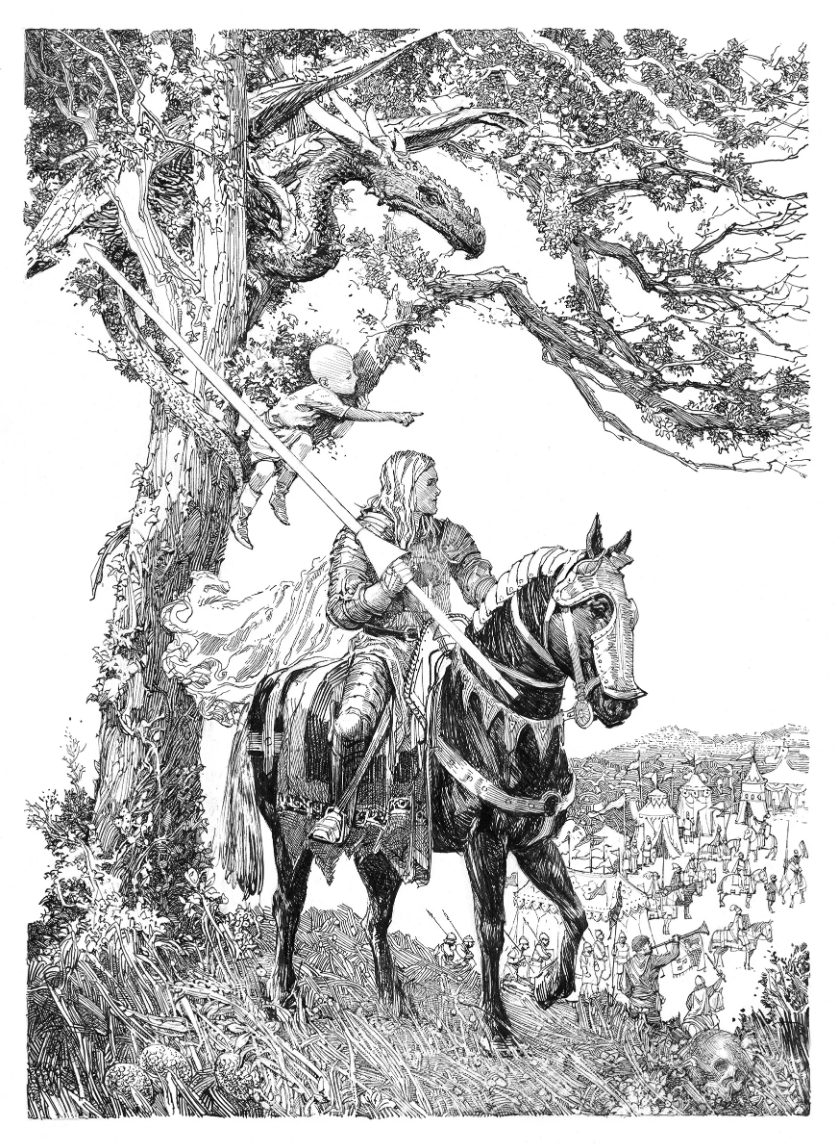
Q: You’ve done extensive work with George R.R. Martin, and he has said that together you find a unique, personal way to visualize each book. What does that collaborative shorthand look like in practice? Is it detailed art direction, or more about trust built over time?
Fortunately, I’ve worked alongside people who’ve trusted me with their properties. Big responsibility. A story can be compromised by the wrong sort of illustrations. A good writer communicates vivid imagery directly to a reader’s mind, so why bother bringing in a middleman (an illustrator) to gum up the works?
I posed that question to George R. R. Martin when working on his novel The Knight of the Seven Kingdoms. He told me he likes to see what artists do with his work. That’s a generous attitude to have, but it certainly puts a heavy load on an illustrator or a filmmaker to honor the integrity of the subject matter.
Q: Fine and small press has exploded in the last decade, and you’ve been a huge contributor alongside presses like Subterranean Press, Curious King, Lyra's Books, Arete Editions and others. From where you sit as an artist working across several of these presses, what's different now versus when you illustrated Wandering Star's Solomon Kane and Bran Mak Morn books in the late '90s and early 2000s and is there anything that uniquely excites you about this recent movement?
The explosion of fine press publishers is a reaction to the modern-day reading habit, which for most people, is online. It’s the twilight zone for newspapers, magazines and books, they are largely replaced by digital formats. A mighty loss for illustrators and writers who made a living in these areas. But as it’s said, for every door closing, another one opens. And honestly, new technology has made some things easier for artists.
When Marcelo Anciano and I started the Wandering Star series of Robert E. Howard books 30 years ago, we shipped huge paintings back and forth from the U.S. to the U.K. Expensive and time consuming.
Designing a book was an even more laborious process. Details had to go through the mail. Also running to the library searching for references. While I don’t do any digital art, I rely on other artists to color my ink line drawings for comic books. So, with the flick of a few computer keys, Presto! It’s great we have all the technology on hand, but it makes the artwork done by illustrators of 100 years ago even more breathtaking.

Q: Is there a book, author, or character you've wanted to illustrate for years but haven't had the right opportunity or publisher for yet?
Regarding which books I’d like to illustrate, I can’t say. I’ve never been very good at thinking beyond the work in front of me.
However, I can tell you what I won’t illustrate…
Most of the popular classics have already been done. Many have been produced more than once by different publishers. Treasure Island, illustrated by N.C Wyeth is probably the gold standard. Bernie Wrightson’s Frankenstein is another. Sure, there might be other ways to interpret these books but for me, these artists nailed it.
Some film adaptations of books are so ingrained in my head it’d be difficult to find a personal approach to the subject matter. The Time Machine, Moby Dick, Mysterious Island, Dracula, and there are many books I admire by Somerset Maugham, Mark Twain, Dashiell Hammett, Ernest Hemingway and so forth, but they don’t need to be illustrated. At least not by me.
I have illustrated H.P. Lovecraft’s Call of Cthulhu, but he is, alongside other horror writers, tough to illustrate. The tension in these stories lies in the protagonist’s subjective viewpoint and the terrors are often inferred more than seen. The “unseen” makes them even more terrifying. So, why illustrate it? Authors like M.R. James, Shirley Jackson and Stephen King are spine-tingling and, arguably, work best in the theater of the readers’ mind.

Q: Fine press has, in some ways, positioned itself as a counterweight to mass-produced and AI-generated imagery, leaning hard into the value of a human hand and a physical object. Do you think that's a real, durable distinction for readers and collectors?
All the Fine Press books I’ve been involved with are works of art in and of themselves. My illustrations are only one component. It takes a dedicated team of artisans months, if not years, to produce small print runs. Books are made by hand with exceptional materials. Labors of love created by people who take pride in their craft and meager profits are secondary to making the best book possible. A rarity for these times. I imagine the monks who created the Book of Kells in the 9th century would applaud the efforts of their 21 century counterparts!
There is a big distinction between collectors and readers for these objects. Two different groups with some overlap. The value of the human hand crafting a fine letter pressed book is highly prized, as it should be, to a collector. It will be well preserved and delicately handled. Not sure that matters much to a reader. For the passionate reader, there’s a different set of criteria at work in the appreciation of a good book. In an ideal world, I’d like to see inexpensive trade editions find a marketplace shortly after high-end editions are sold out. I suppose this idea is contrary to the business model of Fine Press publishers and collectors but consider this, you can buy a cheap twenty-dollar paperback of the Book of Kells. It doesn’t affect the value of the original in the museum case few will ever see.
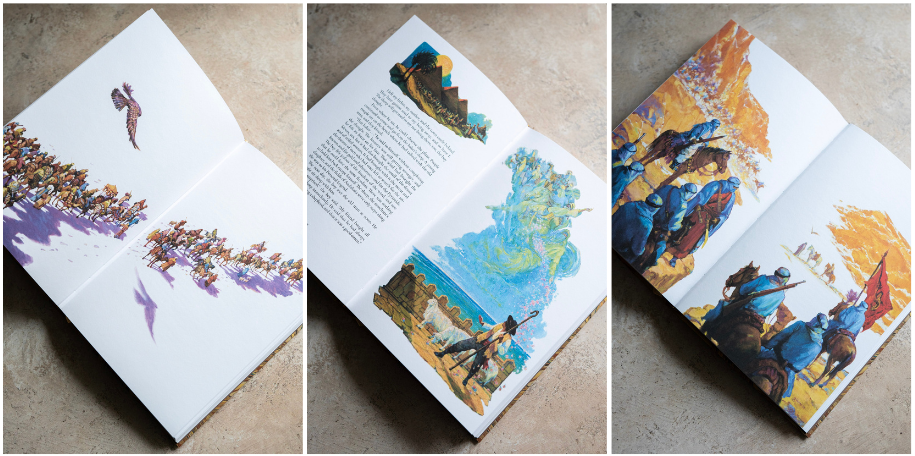
Q: There's an argument to be made that your work has stayed so relevant for decades precisely because it never chased trends, it draws on Golden Age illustration (N.C. Wyeth and that tradition) rather than whatever's current in comics or concept art. Do you see that as a deliberate stance, or just where your eye naturally lands?
It’s difficult to be objective about my own artwork. The simple answer is, I just wanted to create art like the artists I admired since childhood. Isn’t that what we all aim to do? To be like the people we look up to? No complicated answer there. I’m not interested in analyzing the subject too much. There’s a danger of becoming too self-conscious. Reminds me of a Japanese parable of a little fish who began to question how he’s able to live underwater. He becomes obsessively self-aware of the idea and eventually drowns.
Q: What is it about a hand-bound, illustrated, limited edition that you think still matters to readers in 2026 — when most fiction is consumed as an ebook or audiobook? What is fine press actually preserving?

I’m currently working with Marcelo Anciano on an Arete Fine Edition of Edgar Rice Burroughs A Princess of Mars. The book has had hundreds of thousands of fans including authors like Ray Bradbury and Michael Chabon who’ve been captivated by the story since they were kids. I‘m well aware of all the great illustration work accompanying the Mars novel but I’m embarrassed to admit to only reading it recently.
How did I miss this cornerstone of literature for all the fantasy and sci-fi adventures I’ve been inspired by throughout my life? Reading it at this stage of my life, I find the 1912 story to be an intriguing timepiece filled with concepts still being explored by writers today. Because of my former lack of awareness, I have a slightly different point of view of the way it’s written as opposed to those who grew up with book. With that in mind, I decided to illustrate it.
It's my hope other readers unfamiliar with Edgar Rice Burroughs work will pick up the Arete edition (or any other edition) and discover the charms of The Princess of Mars for themselves.
This interview was done in a series of communications back and forth and we want to thank Greg for his willingness to be a part of this series and also for collaborating with us on a future broadside. To stay up to date on the breadth of everything he is working on, you can follow him on Instagram.
Interview by: Zach Harney of the Collectible Book Vault


Comments