Art of the Book, Vol. 9

Dimitris Koutsipetsidis - Bookbinder and Toolmaker
Dimitris Koutsipetsidis is an incredibly talented bookbinder based in Greece, known for his meticulous craftsmanship that bridges traditional techniques with contemporary design. Originally he studied literature and linguistics, but transitioned into bookbinding through a deep fascination with the physical book as both a vessel of knowledge and an object of beauty. Not only has he proven himself as a top-tier bookbinder, but he also creates high quality tools that are used by many of his peers and teaches countless workshops to aspiring bookbinders in Europe. He has been a long time friend of us here at Collectible Book Vault and we couldn't be more excited to share some more of his story with all of you!
Q: You started selling handbound books in the Athens marketplace and now have your own studio, teach regular classes on bookbinding, and create and sell your own bookbinding tools used by binders all around the world. Can you talk us through the journey that brought you from there to where you are now and, what were some of the pivotal moments?
I discovered bookbinding about 20 years ago, during my university days. I always enjoyed handcrafting, and during that time, my focus was on working with leather. If you visited downtown Athens in 2006-2008, chances are you’ve seen me selling small leather goods at street markets.

One day, during a book fair, I came across a stall with handbound books and journals. I was instantly drawn to it and had a moment of realization: this craft combined my two halves – books and handcrafting. In the following weeks, I made a few binding attempts on my own, trying to reverse engineer a binding based on how I imagined it was done. I had no tools and all the materials were wrong! I then took the result and began asking around local bookbinders if they would take me as a helper and teach me the craft in return.
While I did spend some months between two binderies, it didn’t exactly work out, since many binders back then still carried an old mindset of being secretive among other reasons. I was so enamored with the craft though, that I kept practicing, experimenting and learning everything I could through self-teaching, which is a rather long and arduous way of learning things, but not without some interesting merits.
I found myself doing mostly design bindings as early on I lacked a proper collection of (classic) decorative tools, which is what led to toolmaking - more on that later though. This had an avalanche effect over time, as what you show is what people tend to ask of you.
Besides deciding to pursue bookbinding instead of my studies and taking up toolmaking, starting a bookbinding blog was also another pivotal decision – don’t know if I would have managed to become and remain a bookbinder otherwise. You see, I got into the craft right at the onset of the 2008 Greek recession. The years that followed were abysmal financially and binderies were closing in droves in Athens. However, as a university student, I wasn’t initially dependent on bookbinding for a living and the blog allowed my work to be seen by people abroad, which set the foundation for my bookbinding journey. I would not have been able to get a footing in the craft otherwise, relying solely on what would be -and still is- a shrinking local market.
While blogs have lost their once central role on the web, I still think of it as the core of my online presence and the real “shopfront” for my work. I might be more active on Instagram, but only the blog posts allow me to showcase my work in depth as opposed to the algorithm-dependent and fast-scrolling world of social media.
Q: Who were some of the biggest influences that got you to where you are today, and who are the modern bookbinders in your craft that you most look up to?
The biggest influences in my journey so far could be divided into three groups.
The first one is binders of the past, like Sangorski & Sutcliffe with their jeweled masterpieces, or Lorenz Schwartz with his wonderfully creative designs and a whole host of other famous binderies and binders/finishers that I could name. Their work is so magnificent and, in most cases, impeccable, that it took me years to realize and accept that I will never be as good as they were - and that’s fine. It was liberating, and it allowed me to focus on the things that matter.

The second one would be seeing the work of my colleagues online. During my first years in bookbinding, there was little about it on the internet, however, as blogs and eventually social media took off, there was no shortage to the beautiful and inspiring work that could be found and the wealth of information accompanying it. In a way, the collective community of bookbinders worldwide has been an ever-giving mentor for me.
The third one would be several fellow binders here in Athens, as well as a long-time client tied to the same group, who embraced me and have supported me along the way through their openness, encouragement and appreciation.
As for modern binders that I look up to, there are many talented artisans who create excellent work – it would be too big of a list to name them all, and I wouldn’t consider it fair to name only some and omit others! That said, one of the things I’ve realized over the years is that you can appreciate particular aspects of someone’s work, regardless of their level of skill or experience in general. Many come up with inspiring designs, work with unusual structures, or interesting materials. They can be great problem solvers and good at improvising as they work. Sometimes it might simply be their perspective on our craft and how they approach creative challenges from angles I would never think of.
It’s easy to fall into the trap of admiring only the top, past or present, in a given field, those who’ve accomplished technical excellence or artistic maturity; they shine too bright and their work demands -rightfully so- our attention in a way that sometimes overshadows the rest of the land. In the end, what I’m trying to say is that rather than looking up to some, I look around to see what is there to discover from our craft and its people.
Q: You create some of the most beautiful and well-crafted bookbinding tools in the industry. Can you tell us a little bit about how this evolved out of personal need and expanded to supplying other aspiring and professional bookbinders all around the world?
Thank you! I never imagined I’d be so invested in toolmaking, to the point that it has become equally dear to me as binding books.
My first attempts were born out of necessity, as I couldn’t afford proper decorative tools, and an innate curiosity. I had some basic skills in traditional jewelry-making and thought I could make my own tools through wax models and have them cast, instead of spending a lot of money trying to slowly acquire classic designs. Making the first one felt like I had invented fire. There's something infinitely fascinating about unlocking the ability to create your own tools: it is like discovering a whole new world underneath the one you're passionate about - entwined with it but completely different. It also kind of tugs at my fascination with the concept of a “Craftsman Universalis,” a term I like to use paraphrasing the idea of Homo Universalis from the Renaissance.

Learning how to properly make something is, of course, far more expensive in the long run than buying it. For what’s more my first attempts were, let me put it kindly, rudimentary… But I had lots of time to spare and didn’t realize how complex and costly such a process would be, so I began my descent down the toolmaking rabbit hole – and thank God for my ignorance back then!
Even though toolmaking is something I also had to learn on my own, I was much luckier in climbing this skill tree since there’s a lot of relevant information online, especially when it comes to machining, which I began transitioning to in later years. In many ways, I think and approach crafting as an engineer, so it clicked perfectly.
After some time, I decided to make a few of my tools available and the response was quite positive from the get-go, something I feel very grateful towards the bookbinding community for. The fact that I was a bookbinder and thus knew the use of the tools and how to properly optimize them made a difference and offset my initial lack of toolmaking equipment.
Many came to be simply because I didn’t have a certain tool, so I made it. In other cases, I wasn’t quite pleased with what was available, or saw a way to improve it or make it more suitable to how I work, so I experimented. And since I will be using them on my own bindings, I am a strict critic of the outcome. Even when I’m pleased, I never stop thinking of ways to improve existing designs. Some of my available tools are the 4th or even 5th iteration, if one counts the prototypes.
While functionality and ease of use remain the priority, a lot of effort goes into their aesthetic as well. Tools are the extension of an artisan’s hand, the means by which skill is transformed into something tangible. As such, they need to be beautiful besides useful, as they’re not just means to an end but also the binder’s companions.
Q: Your bindings are a wonderful blend of classical techniques applied with modern aesthetics. How did you develop towards your current design aesthetic and what do you think was the first binding you did that captured what you would be trying to achieve moving forward?
This is a rather challenging question, since answering it properly requires a clear-cut definition of what my aesthetic actually is, in order to trace its development, whereas I’m still very much in the process of understanding and trying to define it.
For the most part, it’s been an unconscious process, realizing I’ve stumbled upon something defining only when it happened, either when coming in touch with a specific work of art, place, experience, or when I come up with an idea that’s not just a solution to a creative challenge but has a direct link to my core. In recent years, I’ve began an effort to explore it in a more active manner, though there’s still a very long way to go.
As for the binding that marks the initiation of my aesthetic, it’s not one but three.

The first project in that regard would be the three bindings for “A Matter of Laws.” The books revolved around criminal laws, each focusing on a different part of the field. As I was working, I realized there are a lot of similarities between Law and Physics/Mathematics; they mirror each other in interesting ways, and so I based my designs on the latter. This acted as a spark, effectively introducing the elements of symbolism, storytelling, and layers of meaning into my work, which I consider very important in my artistic approach.
The second binding was “A Story of Hope”. This was an unusual love story set in a post-human dystopian London. The design of that binding is the first time I explored the concept of a secret world/language: creating a design, or certain aspects of it, using a set of rules I’ve come up with, inspired by the book at hand. The result is like observing an ancient scripture: there’s an underlying order governing the details, leading to something that feels coherent, immersive and inviting exploration, but the specifics remain elusive to the viewer.
Lastly, the binding project that has contributed possibly the most to what constitutes my creative identity is “The Portrait of an Aesthetic Surgeon”. Through various elements, such as the design, its enclosure and the accompanying short story I wrote for it, the binding becomes its own work of art - working in tandem with the book it is based on but at the same time transcending it. I believe it is the first project I did with the artist in me fully involved.
Q: Bookbinding is an interesting profession because to do it well, you need to be equal parts manual craftsman and artist. Is there a side of the bookbinding process that you resonate most with or do you enjoy every aspect equally?
On a first level, I enjoy both equally. I could sum up the answer as “I was drawn in by the crafting, stayed for the art.”
I enjoy the structural aspects of the craft, working with the tools and the materials, improving my skills step by step as the years go by and seeing them translated in the end result. Handcrafting is fulfilling and often humbling. And it makes sense: at the end of the day, or week or month/s, you’ve created something out of nothing. It’s not just numbers on spreadsheets, but out there, as real as it can be, and someone will hold it in their hands and, hopefully, value it.

I enjoy the artistic side of it as bindings are infinite in their possibilities and yet specific in their form and complicated function, to which an immense number of materials are applicable. Depending on its content, the book inside a binding is a small ark of human thought, knowledge, or creativity, written/created by someone else or even the binder themselves. Or it can even be blank pages for a future author. There is so much freedom, exploration, symbolism and challenge involved in bookbinding.
I also enjoy both sides because they are communicating vessels - each elevating the other. Sometimes I have an idea and have to develop/improve the skill to make it happen, other times I have the skill and am in search of the idea or waiting for the project that will put it to good use. If I had to dig a bit deeper though, I’d say the artist in me probably has the upper hand, even though his presence is not as essential as the craftsman’s. I don’t think I’d enjoy being a bookbinder as much if I were only to make bindings without any artistic creativity involved. Similarly to what I wrote earlier regarding tools, we are not just automatons and thus what we make is not mere function: we need beauty and meaning.
Q: When a client comes to you with a binding project for a book that you haven’t had exposure to, how do you go about approaching that particular design and then capturing the essence of that story in your binding?
If it’s a title I’ve never heard of before, I will do some research on the book’s story and overall context, such as when it was written, who was the author was and their sources of inspiration, the impact it had on the general zeitgeist, etc. At the same time, I’ll also encourage the client to tell me about it from their perspective: its themes, what makes it a distinct piece of literature in general and important to them in particular.
There’s an extra challenge when the book happens to fall within my reading interests and potentially enters my to-read list, as reading analyses and discussing it with the client while avoiding spoilers can be rather tricky!

After that, it’s the same as with books I’m familiar with: finding a connection to the story, which can happen in many different ways. It can be through its themes, a single scene or image, the way the client connects with it, a thought born from reading it, or about it. Might be something completely abstract or very specific. Or it can simply click with an idea I’ve been wanting to try for a long time and was waiting for the proper book to come along.
Inspiration is an elusive thing and I have little control or access to that part of my mind. There are some things I can do to create fertile ground and invite inspiration, however they’re not always guaranteed to work. I might have a great idea from the get-go or it might take many months before one presents itself. It kind of feels like those pneumatic tubes that were once used to deliver messages and small items throughout a building: I’m often doing other things when suddenly -pop!- the idea is delivered from the depths of subconscious thought.
What follows is evaluating it and finding ways to implement and showcase it properly, which is often a complicated and multi-step process. Ideas are great, but it’s often the how and not the what that makes all the difference.
Q: You have begun teaching classes to aspiring bookbinders and do this on a fairly regular basis. How did your first class come about and why is this so important to you amidst all the projects you have going on and the busy work schedule?
I’ve been teaching for most of my bookbinding career, however, I started doing Fine Binding workshops when people began asking me to, about three years ago. Teaching fine binding is far more involved and intricate compared to other workshops. The process includes dozens of stages, requires a certain level of skill, and is not very forgiving when it comes to mistakes.
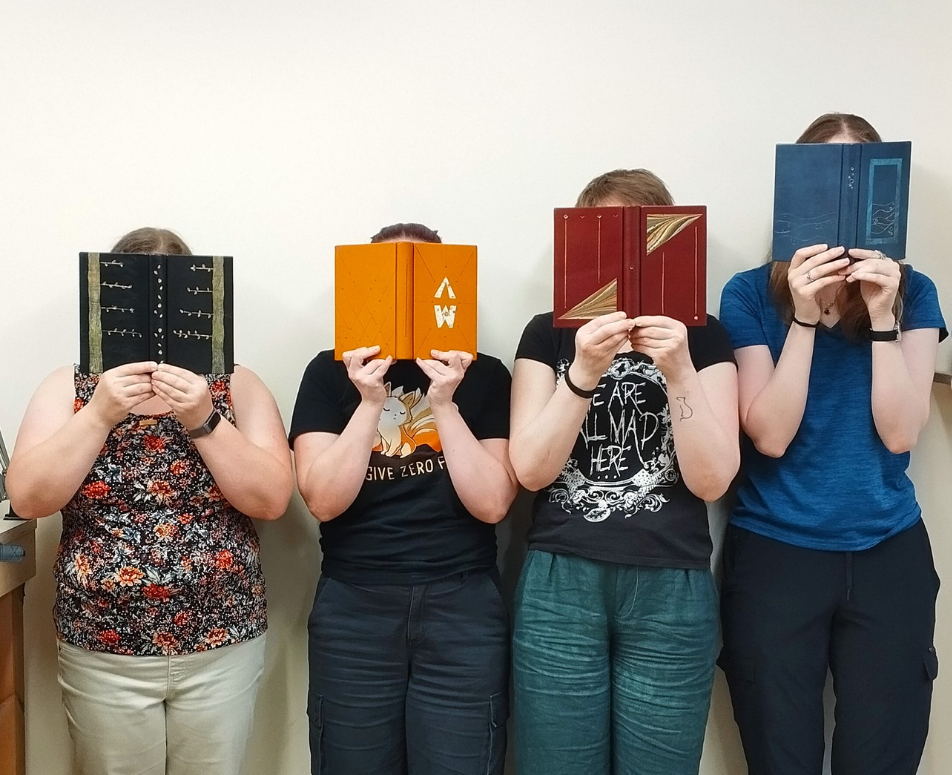
Those interested in fine binding are usually bookbinders in training, established professionals who would like to improve their work and portfolio of services they can offer, or even very passionate hobbyists. In all of those cases, they have already invested a lot of time learning and practicing, are passionate about the craft, and are committed to going even further. Who doesn’t want to share their skills with such a student?
Teaching is not just a privilege, but also an obligation, for me at least. When I first got into bookbinding, the majority of binders in Athens were still apprehensive to share their skills and knowledge and there were very few things about it online. I wasn’t able to get the guidance I needed and had to learn most things on my own. I would like to be something different to those wanting to learn, to invite them into the world of bookbinding, offer them advice based on my experience and help them avoid the mistakes I did along the way, so that they might make the most out of their time devoted to the craft.
Q: Historically, the vast majority of your projects have been individual design bindings for specific customers. Many of our readers enjoy your work and would love to see you involved in an edition binding at some point for a fine press. Is this something you would ever be open to, or do you think the repetitive nature of an edition binding would be something you would shy away from?
It's actually something I’m quite interested in. Repetition is not always a bad thing. In a certain context, it can be stress-free, relaxing, even meditative. As much as I enjoy the creativity involved in custom commissions and coming up with new ideas constantly, doing so for every single project can get draining. Working on a concept once and then applying it to a number of bindings would be a pleasant change of pace every now and then.

That would work best if the proposed edition is more aligned with my approach, workspace and equipment: a small number of copies and the desire for custom work with attention to detail, as opposed to production in volume and designs that require big stamping plates and heated presses. Something aiming to look and feel unique and personalized.
Another reason I would enjoy taking on a fine press edition is that it could potentially allow for the exploration of certain things, that are usually not possible with commissions from individuals. A good example would be metalwork: I have the ability to create custom brass details, ornaments, clasps or even functional contraptions! The cost of doing so for one single binding is usually prohibitive for the average client, but an edition could be a whole different story as researching, designing, testing and making such parts in multiples is far more viable.
Q: If you could choose one piece of literature to create an original binding for, in collaboration with an established fine press, what title would that be? Why would that be of interest to you specifically, and who would you like to work with?
So many possibilities, hard to choose!
In the last 5-10 years, there’s been a renaissance of small and not-so-small fine press houses, creating stunning editions with attention to detail on all levels: excellent typography, quality of paper and collaboration with talented artists and skilled bookbinders. One of the things I particularly like is seeing all that effort and passion often devoted to “unlikely” titles. The early 20th century has given us many sublime editions, the French were particularly prolific but they rarely veered off the classics. Whereas now you see great editions being produced for sci-fi titles that a few decades ago wouldn’t even be considered “serious literature.”
With all that in mind, I can’t think of a specific fine press I’d like to work with, as there are many doing amazing work. It would be nice if it were a fine press that is not just looking for “hands” but is interested in my creative approach and the skills I bring to the table. I believe this would lead to a great collaboration, making the most out of the skills and expertise of both sides.
I’m afraid I’ll also be vague concerning the title, as experience has shown me that inspiration can be found in books I would not have expected. That said, a great fantasy or sci-fi title, which is my favorite genre, would be my preference. A lettered or roman numeral edition that would allow for custom metalwork would be a dream project; I have some ambitious ideas on that front…
Q: As your career has grown and you have expanded into so many areas, how do you go about choosing your future projects and prioritizing your time? Are you having to be more selective with what you are taking on and how do you determine what that should be?

I’ve been fortunate enough to always have work in the backlog, which in turn has unavoidably led to some amount of selection - I can only make so many bindings within a given period of time after all. I also learned early on that not taking on some commissions and instead focusing on existing ones and leaving the door open for better opportunities is often far more beneficial, even though it might appear as a financial loss at first glance.
In recent years I’ve moved to a stricter selection, both when it comes to commissions from clients and also concerning personal projects. The fact that my year is interspersed with toolmaking and teaching besides bookbinding is crucial in planning: it’s three different trees in the same garden and I only have a certain amount of water. Allotting more to any one of them directly affects the growth of the other two.
As to what determines whether a project is accepted, there are many factors at play…
Is it interesting?
Maybe it involves working with a beautiful edition or a book that’s dear to me. Maybe there’s a heartwarming purpose behind its commission. Perhaps it comes with a fascinating challenge or the opportunity to try something I’ve been wanting for a long time.
Is it from a long-time client with whom there’s been a pleasant collaboration?
I strongly believe in cultivating lasting relationships between an artisan and their clients, based on shared knowledge, trust and understanding, as that allows us to enjoy working with each other and be happy with the result.
Does said project disrupt my planning for the months to come or affect other existing projects?
No matter how good a project is on paper, if it jeopardizes the Jenga tower of what, when and how of other commissions to a big extent then the resulting problems and stress are not worth it.
Is there potential for follow-up projects or a collaboration on a regular basis that will contribute in sustaining my bindery and livelihood?
Does it require doing things that will steer me away from the direction I’ve taken as a craftsman/artist? It’s one thing to step out of my comfort zone and try new things, and another to take on something that works at a completely different frequency of what my skillset and bindery’s setup are attuned to.
I balance these and other considerations and see which side the scale tips.
Q: If you could look forward into the future 10-20 years, where do you hope that you will be from a personal and business standpoint in your career?
Only in recent years have I realized what I’m capable of as an artisan and the direction I want to follow in order to turn that potential into creation. I feel like an archeologist of myself - there’s an entire world hidden inside and I’m bringing it slowly into the light: mysterious cities and intricate artifacts lie covered and only the shape of the land or some bizarre part peeking out are a telltale of their presence. I believe I’ve barely scratched the surface when it comes to skills, ideas and creativity.
A lot of things need to go right for that to happen: the right projects need to come along, and the timing must be right in terms of how well the bindery is doing, headspace, inspiration and health.
Twenty years is a long time, even ten. Sometimes I just hope I’m still around, still a bookbinder, and if those two apply, I’ll figure out the rest.
This interview was done in a series of communications back and forth and we want to give our sincerest gratitude to Dimitris for his openness and generosity of time. If you want to keep up to date with what Dimitris is currently working on you can check out his website or follow him on Instagram to stay on top of his inspiring binding work, toolmaking, and see what wonderful creation he will come up with next!
Interview by: Zach Harney, co-founder of the Collectible Book Vault


Comments